













FAIRFIELD – There are 116 Community Colleges across the state all of which need to have an Student Equity and Achievement Plan (SEAP) every three years. Colleges are expected to examine their student success data and identify gaps where student populations are disproportionately impacted, how the college can make improvements, provide more opportunities for students, and create a better environment so students have the ability to thrive.
Solano is currently finalizing their third SEAP which covers the years 2025-2028 and focuses on African American, Latine and LGBTQIA+ students as examples of the populations they’re looking to support, but not everyone has been happy with the process.
Financial Aid Specialist Antoinette Troupe-Gardner who has been at Solano for 25 years, 15 of them in Financial Aid, said the plan aims to “build transparency, equity, more inclusion, student safety, and academic support for all students and all races. The desired outcomes that students should feel supported, seen, and heard at the seat of the table in order for change to actually take effect.”
Analysis of the previous SEAP shows a success rate of 58% of students completing English and Math, with 38% of students who didn’t sign up for English during their first semester in enrollment. From 2021-2022, there was a 57% completion rate; This number would then plummet to 39% of students who were able to complete English and Math during their first semester.
“The data is just something collected once we have made efforts towards creating the change that we want to see, but the actual data that we want to see needs to be changed because it’s currently not in the state or condition that we would like it to be,” Troupe-Gardner said.
“We love our students and it needs to reflect that and we want that to be reflected so it’s very important for us to create the Student Equity and Achievement Plan that has many minds included.”
According to a Nov. 19 Board of Trustees presentation from Vice President of Student Services Lisa Neeley, the SEAP, “empowers California community colleges to advance equitable student success by increasing academic achievement for all learners and purposefully closing persistent equity gaps for disproportionately impacted student populations.”
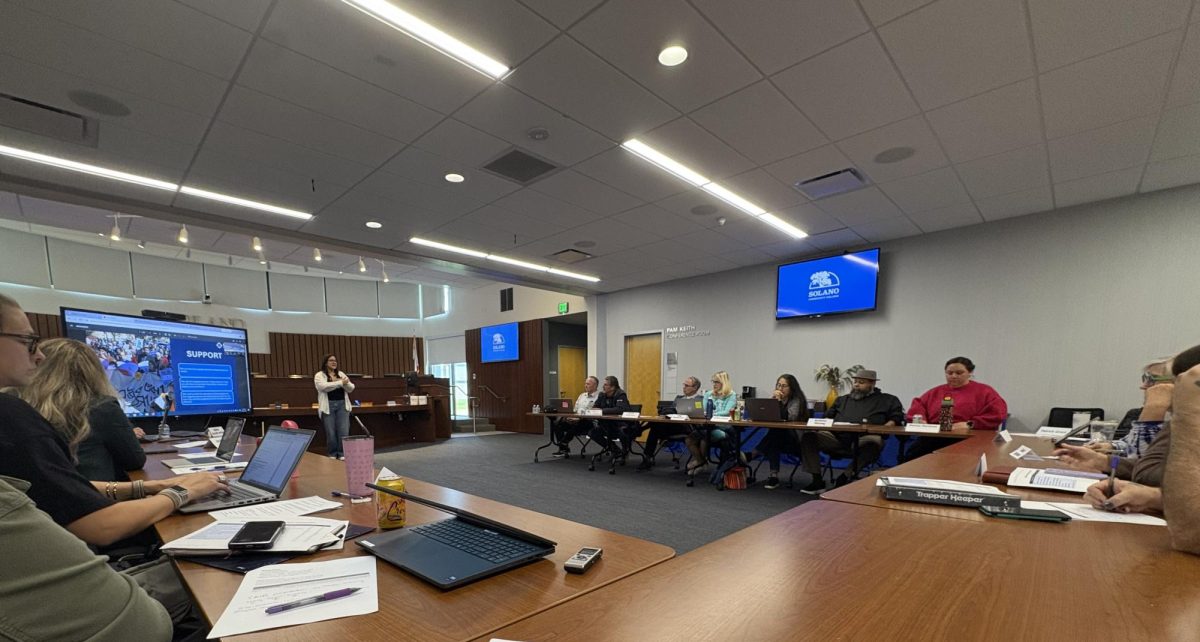
As recently as Monday, Nov. 3, students, faculty and administrators came together to review a draft of the 2025-2028 SEAP in a meeting led by VPSS Neeley and Dean of Research and Planning, Nathan Rexford.
Articulation Officer Ashlie Lawson, who was at the meeting, said that they have been looking at the quantitative data and identifying gaps throughout the development of the SEAP, because there are “barriers in place…preventing [students] from being successful and we need to take down those barriers and try to provide more resources for Solano students.”
Lawson mentioned that they do not look at faculty data but only student data. To address this problem they would have to get faculty union support to look at data from Research and Planning.
Including the Nov. 3 meeting, Neely’s office has been working with students, faculty, and other groups on campus to create an ongoing dialogue.
These conversations are “an opportunity to meet the needs of the Chancellor’s Office” and also meet “the needs of our students, here on campus” Neeley remarked.
When we look at the data on Black student success “we are not hugely different than a lot of the other colleges, and, in fact, nationally,” she stated.
“With that being said, Black students are failing and we have more to do as the system of higher education is to understand that the issues on the ground provide the support and resources to help students which is what the SEAP plans allows us to be very intentional about” Neeley furthered, in a follow up interview.
Neeley said, “The Student and Equity Achievement fund is a little over $2 million a year and, for most colleges in the state, the majority of it goes to staffing and that there are many ways to give money directly to students including financial aid and basic needs.
Neely added, “I think the system is failing Black students because it was never designed to really, truly support all of our students, in all of their diversity, and all of their lived experiences, but yes, there are issues with Math and English.”
Neeley pointed to data that shows that when students pass math and English in the first academic year, it “incrementally and exponentially increases Black student success or likelihood of success in terms of reaching their goals” which is why the college has “a big focus on that.”
“We need to do more because we need more Black students to actually try to take those classes because that’s the hard part,” Neeley explained. “We know that K-12 does a number of students, and they come in necessarily not having an equitable experience, and so they come in and sometimes won’t take those classes so we’re trying to encourage more students and then provide the support to help them through.”
Associated students of Solano County employee, and former Black Student Union President, Alexis Lusk expressed her concerns with Black and African American students not meeting the goals that were established in the 2022-2025 from the SEAP.
“It is very sad,” Lusk stated.
“At Solano they do have a lot of Black students here that, in my opinion, do tend to get overlooked and under served,” she added.
She expressed concern that students were not told ahead of time of these SEA meetings and the administration is hiding the data to keep people from panicking, but “this is what they need to hear from students.”
“Solano has an issue with just giving us the facts. It takes them a while,” Lusk said.
In the Nov. 3 meeting, it was announced that $825,753.56 in SEA spending is unaccounted for. Lusk argues that money should be going towards Student Government or used for textbooks.
At the meeting, Neeley spoke of the positive outcomes from the last SEAP such as the Basic Needs Center, Outreach to Black students, and the Black Family BBQ, Black Cultural Center, Pride Center as well as the Falcon Flyer.
When asked, later, why students were not involved in the current plan, Neeley explained that some students did participate in the SEA working group but, if there are gaps, then “we need to do a better job.”
Work on the current plan began in April with direction from the chancellor’s office. Since then, Neeley’s office has held more than a dozen meetings and conversations, including ASSC, Academic Senate and Student Equity and Success Council.
Troupe-Gardner said that there needs to be a way to send out text messages notifying that these SEA meetings are being held for students and faculty, but that it would have to be a ahead of time “so students won’t feel left out of what is being heard, since this is supposed to be done on their behalf, we are the representatives, and we know what it is that may help us in different areas, so it’s very important for the student voice to be present.”
Troupe-Gardner said that there needs to be a way to send out text messages notifying that these SEA meetings are being held for students and faculty, but that it would have to be a ahead of time “so students won’t feel left out of what is being heard, since this is supposed to be done on their behalf, we are the representatives, and we know what it is that may help us in different areas, so it’s very important for the student voice to be present.”
For students who don’t feel like they are thriving, Troupe-Gardner would try to encourage them and let them know that there is a space and time that is carved out for them. Even though they’ve had a bad experience, felt disappointed, and not been heard or considered on different levels when it comes to attending Solano Community College “that there is hope but there are people that here on campus with the right mindset pushing the right agenda.”
The SEAP is due to the Board next week and VPSS Neeley will continue to hold meetings all the way through.